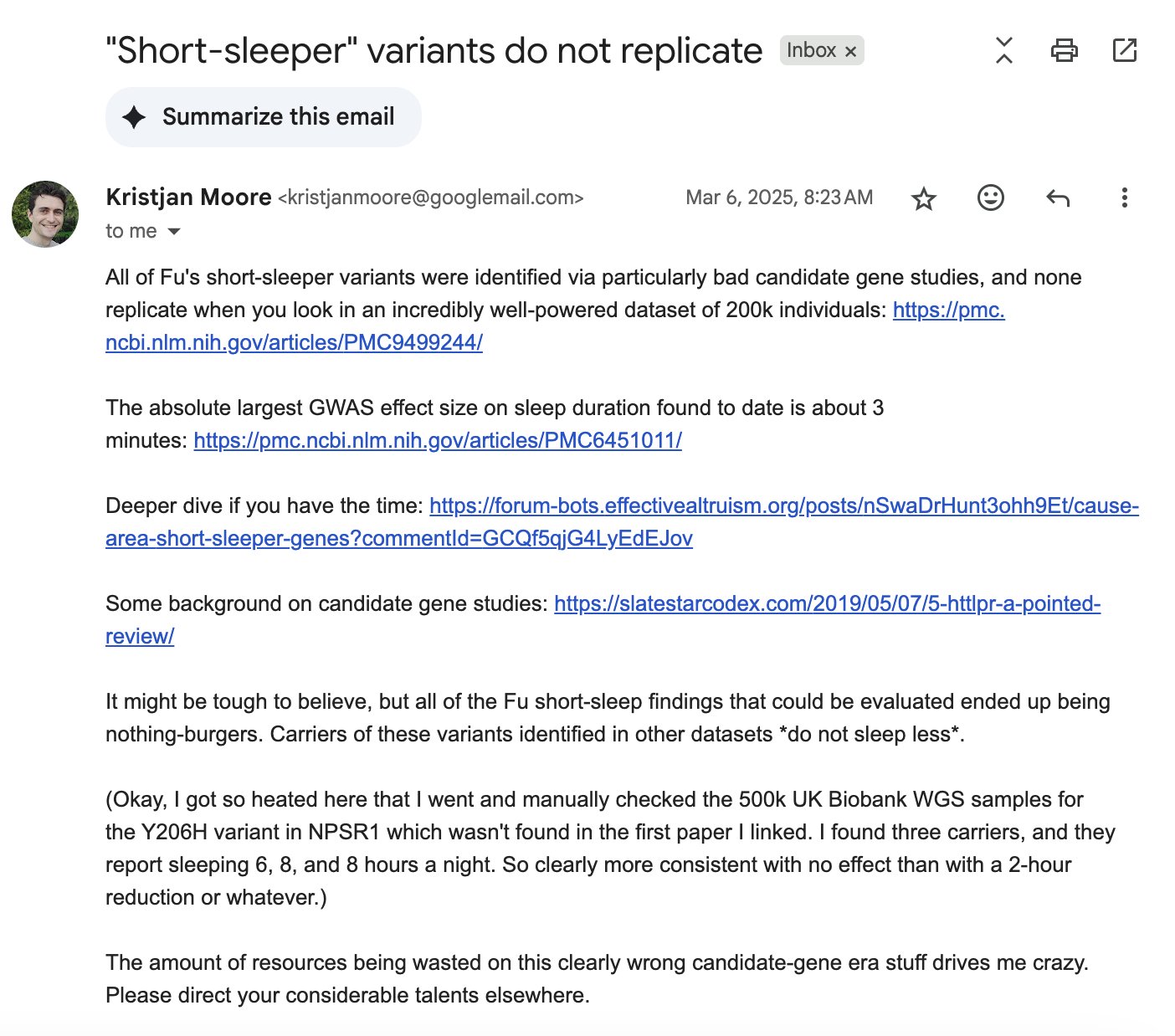
In March Kristjan Moore from deCODE genetics emailed me urging me to stop working on short sleep.
I read paper in question since Jan, but was still hoping/coping that maybe NPSR1 variant (not included in the paper) would replicate.
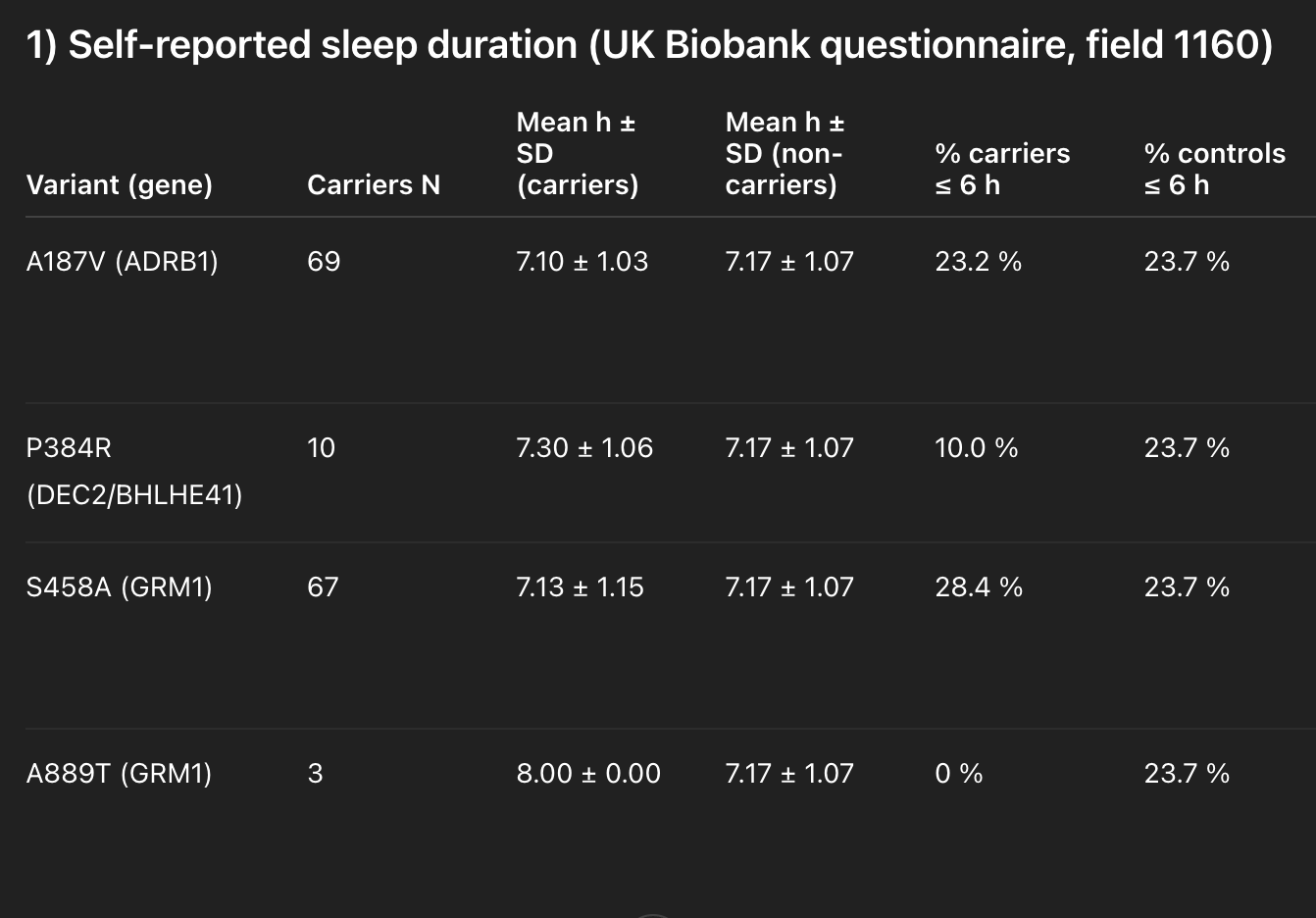
Of the five published short sleep variants, the paper found carriers of four of them in a ~191,929 person database with both genome and sleep data. Here’s how many carriers they found for each variant:
- ADRB1 A187V = 69
- DEC2 P384R = 10
- GRM1 S458A = 67
- GRM1 A889T = 3
Across all found carriers, average self-reported sleep duration was ~7 hours, and the fraction reporting 6h or less sleep was lower or equal to non-carriers.
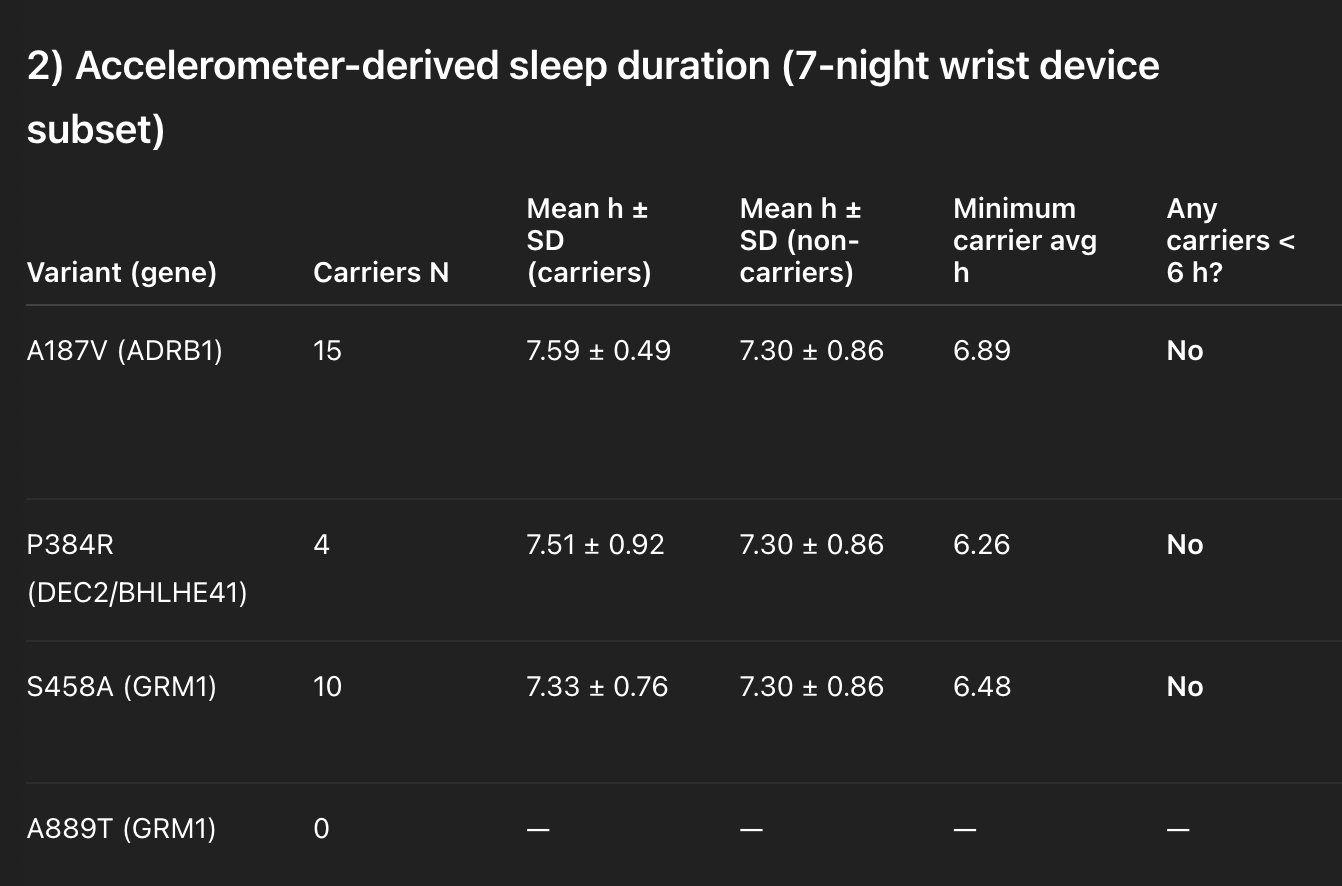
In carriers with objective sleep duration data measured from wearing motion-tracking watches, the results mirror the self-reported data. All carriers slept similar durations versus non-carriers, and none slept below the 6h “short-sleep” threshold.
What about NPSR1 Y206H, the one variant that was so rare it did not show up in the ~200,000 person database? Turns out three carriers exist in newer versions of UK Biobank, which Kristjan manually searched and found. They slept 6, 8, 8 hours each night.
If the true population mean sleep time of NPSR1 Y206h carriers was 5 hours, the chances of drawing three 6+ hour sleepers would be 0.6%.
Here’s a table of probabilities of randomly sampling the 6, 8, 8 hour carriers given increasing true population mean sleeping time.
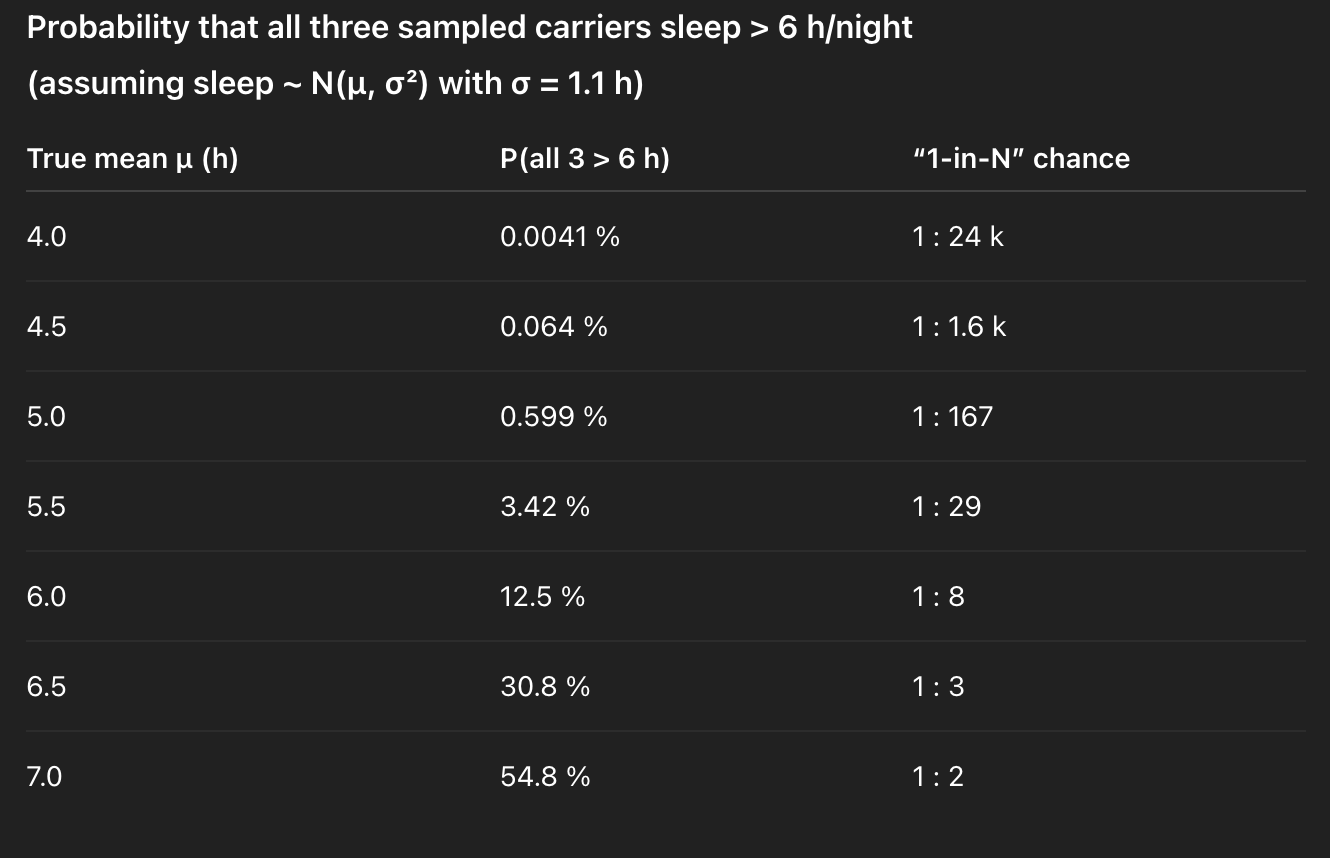
Its exceeding unlikely (<1%) the true population mean sleep duration of NPSR1 Y206H carriers is 5 hours or less. The study that identified the variant in the first place measures 5.5 and 4.3 hours in two members of the same family (original paper).
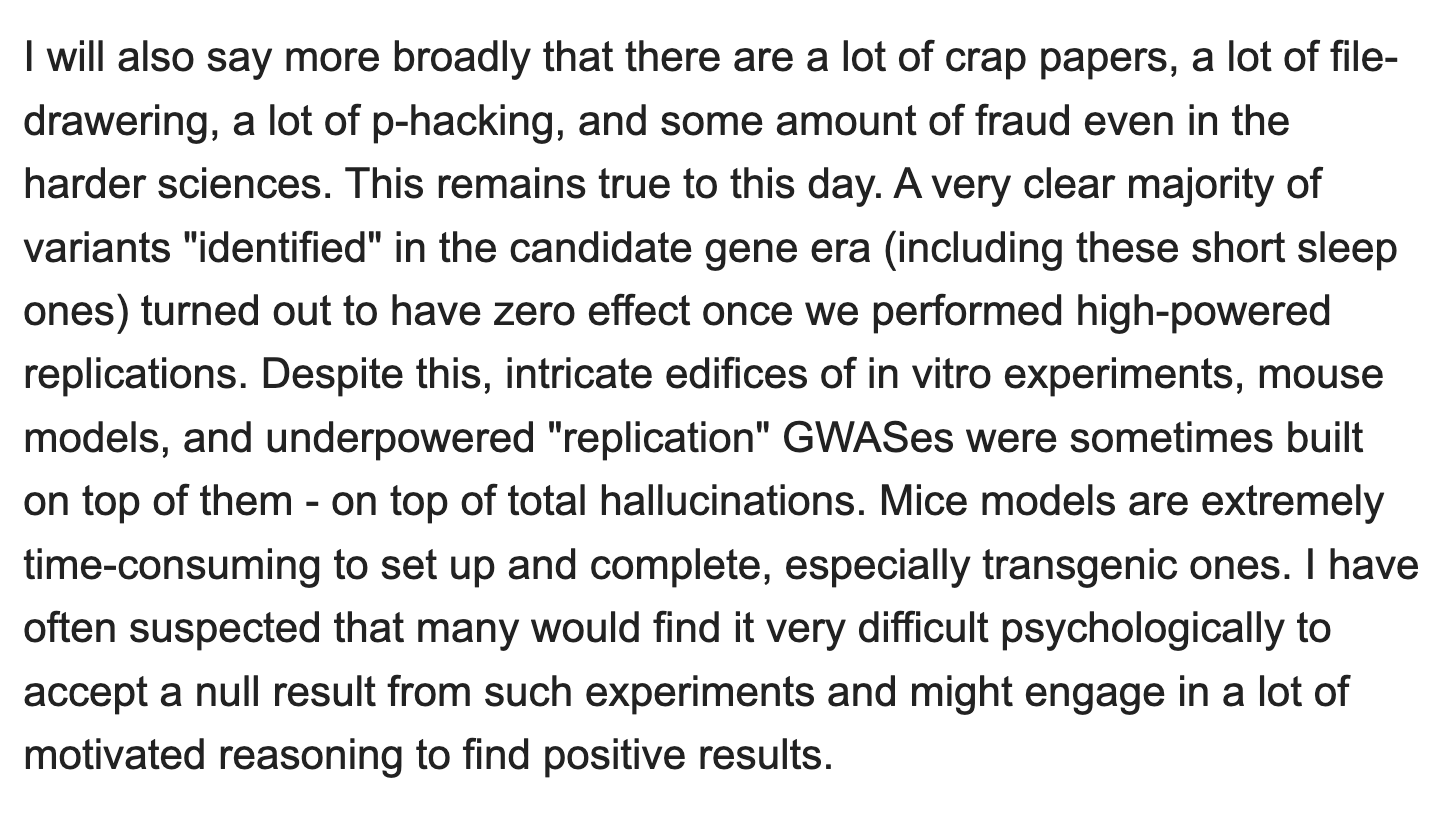
This was a hard pill to swallow back in March. What about the mice studies that showed replication of every variant? What about the in-vitro studies showing clear biomechanical pathways? I rebuffed Kristjan’s answers to these questions back then, but now I echo them:
I had spent 4 months working on short sleep when I got the email. Compared to Ying-Hui Fu, who’s been on short sleep since 2009, my sunk cost was null. But I still had massive cognitive dissonance accepting the null result and chugged on for two months since reading the paper.
In late 2024 I had called with Louis Ptacek, a coauthor on many of Fu’s short sleep papers. I asked him if him and Fu found any GWAS evidence of short sleep working. In reply he said they basically think “GWAS is garbage.” That says a lot about how hard they are coping.
Short sleep was hyped under various names “Ozempic for Sleep” “Sleep Compression” and recently “Human 2.0” by Fu to attract investment. I certainly contributed to the hype. Consequently several orgs have spun up to make “short sleep” therapies. This is a huge waste of money.
Which is why I’m ringing the bell now, to amplify the message that Short Sleep Variants Do Not Replicate. Sure, you could probably make short sleep therapies by making lots of edits. But the chances of a single drug/gene-edit causing short sleep in adults is vanishingly low.
Here’s the link to the key paper that found short sleep variants do not replicate in the general population.
Others links in Kristjan’s email:
- The largest GWAS effect on sleep duration found to date
- Cause area: short sleeper genes (EA Forum comment)
- 5-HTTLPR: A Pointed Review (Slate Star Codex)
I’m testing out a prototype “sleep switch” atm, basically inducing sleep on-command using focused ultrasound. More on it here in my @calculuslab update.
Originally posted as a thread on X on July 2, 2025.